Ragdoll Frenzy Scenes are best understood as sandbox areas for arranging ragdolls, objects, contraptions, tools, and hazards rather than as a confirmed list of named story levels. The game currently confirms a play area and a video reference to trying another scene, but it does not establish scene names, a total count, a map layout, a scene selector, or unlock requirements. Use the current in-game view as the authority for what is available in your session.
That distinction matters when looking for a Scenes guide. You can use the current area to run physics experiments, but you should not expect a reliable checklist of named maps without an in-game label or access screen. The table below separates confirmed uses from details that remain unconfirmed.
| Scene record | Role in play | Access or status | What to do there |
|---|---|---|---|
| Current experimental scene | Sandbox area for physics tests | Enter the game and use the scene currently shown | Place or move ragdolls and objects, then test tools, contraptions, and hazards |
| Another scene | Possible scene variant | A video mentions trying to switch to another scene; the control and requirement are unconfirmed | Treat it as a possible alternative area and verify its name and contents in-game |
| Key-and-door area | Possible exploration or access area | A video repeatedly mentions trying to get a key to a door; its scene role is unconfirmed | Do not treat the key or door as a confirmed progression objective |
The rows are deliberately conservative. “Current experimental scene” describes the confirmed use of Scenes as a place to test interactions, not an official map title. “Another scene” records a reported scene-switching intention, not a proven destination. The key-and-door entry records an observed topic without turning an unclear moment into a formal quest or unlock path.
What a Scene Is Used For
Ragdoll Frenzy presents itself as a realistic ragdoll-physics sandbox. Its public description emphasizes shooting, blasting, grabbing, slow motion, dodging the train, and brutal finishers. In a Scenes context, these are activities you perform inside the current area: the scene supplies the space and nearby objects, while the other game systems supply the actions and effects.
The useful mental model is an experiment space rather than a linear level. Start by looking at the area that loads, identify where ragdolls and interactive objects are placed, and choose one test. You might move a ragdoll toward a hazard, position a tool near a body part, or place an object beside a contraption. The evidence supports this kind of physical testing, but it does not provide a fixed order, score target, timer, or completion reward for Scenes.
This also explains why the scene itself should not be confused with a ragdoll, tool, contraption, or hazard. Those are the things you manipulate or test. The scene is the surrounding play space that lets them interact. If you are comparing two areas, compare their visible layout and available objects in the current game rather than relying on an assumed map list.
Current Experimental Scene
The current scene is the only scene record that can be described without a name or access speculation. After entering Ragdoll Frenzy, use the area currently presented as the starting point for sandbox testing. There is no confirmed requirement attached to this use in the supplied information.
Before activating anything, make a quick inventory of the space:
- Note where the ragdolls or dummies are located.
- Look for movable or pickup objects and the safest open area for repositioning them.
- Identify visible contraptions and hazards before placing a ragdoll nearby.
- Check whether the area includes an obvious door, key, train, acid, or other feature you want to test.
- Decide whether you are testing movement, a tool effect, a contraption, or a hazard; changing one variable at a time makes the result easier to read.
One video gives concrete examples of this style of play by discussing putting ragdolls in acid and showing contraptions. Another describes a contraption grabbing a ragdoll’s head. These examples demonstrate interactions that can be observed in a scene; they do not prove that acid, a head-grabbing device, or any other object belongs to every scene.
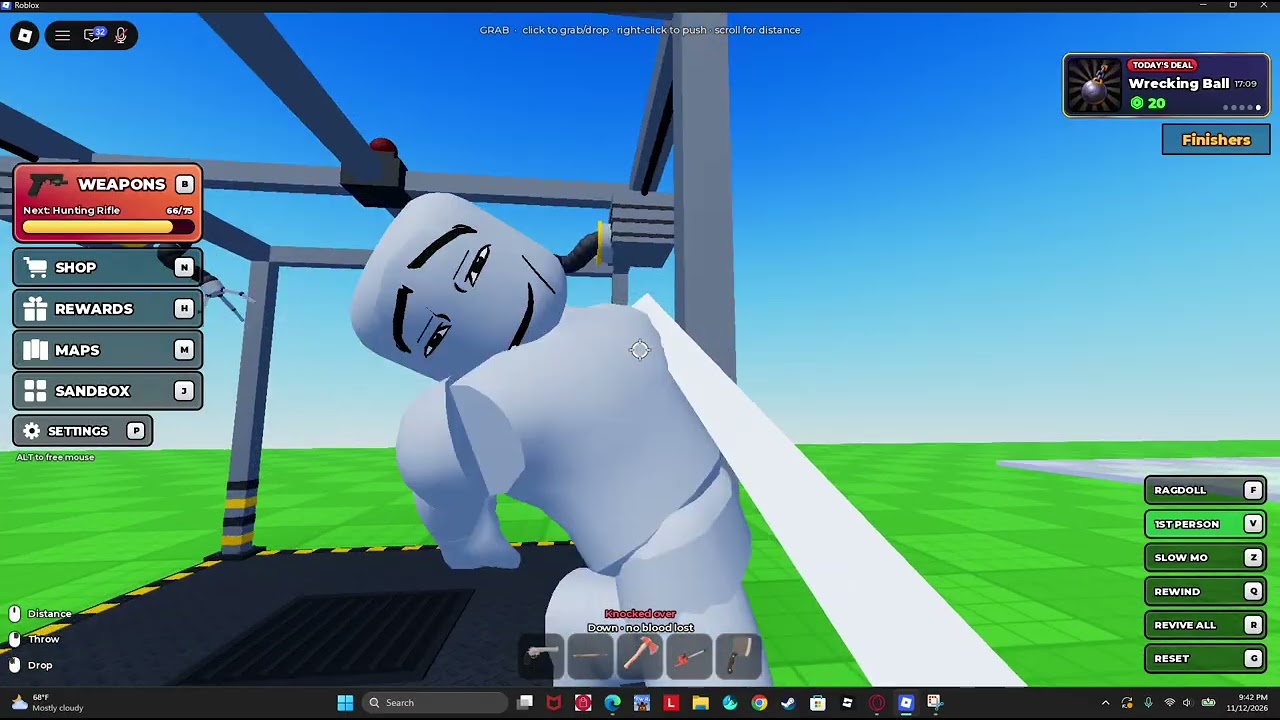
Test acid and contraptions in a Ragdoll Frenzy scene
This moment supports the scene guide’s examples of trying another scene, putting ragdolls in acid, and examining available contraptions without confirming a scene list or switching method.
Running a Scene Experiment
Use this repeatable approach when you want to learn what the current area contains:
- Observe the starting layout. Find the ragdolls, nearby objects, contraptions, and hazards before moving anything. This gives you a reference point if a test scatters objects or changes their position.
- Choose one target interaction. Pick a single question, such as whether a ragdoll can be moved into a hazard or whether a contraption can reach a particular body part. Avoid assuming that a visible object has a quest or unlock purpose.
- Position the test. Use Grabbing to move or hold the ragdoll or object in the area you want to examine. Keep the setup simple so you can tell whether the result came from the tool, the contraption, the hazard, or the physical placement.
- Trigger the interaction. Activate the relevant tool, contraption, or hazard and watch the physical response. Shooting, blasting, grabbing, slow motion, and finishers are part of the game’s described sandbox identity, while the clips specifically illustrate acid and a head-grabbing contraption.
- Compare the result. Repeat the same setup if the first attempt is unclear, then change one position or object. A scene is useful for comparing outcomes because you can reset the arrangement and try again, but no official reset method is confirmed here.
- Record only what the game shows. If you see another area, a named destination, or a clear access prompt, follow that current interface. Do not infer a scene list, unlock condition, or reward from a single mention of “another scene.”
If an experiment becomes difficult to read, move back to the open starting area and simplify it. Separate the ragdoll from the contraption, remove extra objects from the setup if the game allows it, and repeat the interaction. This is a practical recovery approach for a physics sandbox, not a confirmed reset command or formal failure state.
Observe a contraption grabbing a ragdoll’s head
This moment illustrates the physical contraption interaction described in the experiment steps, while the article keeps the device’s availability and scene membership unconfirmed.

Another Scene and Switching Claims
A video mentions wanting to pull another scene while discussing ragdolls, acid, and contraptions. That supports the narrow conclusion that a player referred to another scene or wanted to switch away from the current one. It does not confirm how scene switching works. The video does not identify a menu button, teleport location, scene name, loading prompt, unlock threshold, or difference in available equipment.
If your current game session exposes a scene-changing control, read the label shown by the game and verify the destination after using it. Compare the new area’s visible objects and layout with the previous area before making claims about what changed. If no control is visible, do not assume that a missing button means the scene is locked; the available evidence does not establish whether switching is implemented, where it is located, or whether the video used a version with different content.
The same rule applies to the phrase “another scene” in searches and community discussions. It is a useful lead for checking the current game, but not enough to populate a named map guide. Until a scene name and access method are shown in the game or supported by a reliable public page, keep the record as unconfirmed.
Key, Door, and Possible Exploration
Another video repeatedly mentions trying to get a key to a door. The wording is uncertain, and the clip does not identify the key’s location, the door’s location, the required action, or whether the moment belongs to an official objective. It may be an exploration interaction, but that relationship is not confirmed.
For that reason, do not follow a generic “find the key, then open the door” route as though it were a required Scenes progression. If you encounter a key or door in your own session, first check whether the game provides an interaction prompt or a clear response. Note the surrounding scene and test the interaction without assuming it unlocks a new map. A successful door interaction would still need to show what it opens before it can support a scene-unlock claim.
This boundary prevents two common mistakes. A door visible in a sandbox does not automatically make the area a puzzle level, and a key mentioned in a video does not establish a universal item location. Treat both as optional observations until the game gives a reproducible result.
What Is Not Confirmed Yet
The current Scenes record does not support a named catalogue, a confirmed scene count, a list of layouts, a teleport route, or unlock requirements. It also does not establish that scenes are linear chapters, that every scene contains the same contraptions and hazards, or that changing scenes awards progress. The Roblox description reinforces the sandbox identity but does not list scene names.
When a value is missing, use the current game view instead of filling the gap with a guess. Check the visible scene label, available controls, object placement, and any prompt shown during play. If the game changes over time, those in-game details are more useful for the current session than an old scene list.
The practical takeaway is simple: enter the available area, inspect its layout, and use it to test ragdolls and physical interactions. Compare another area only after the game clearly identifies one. Keep key-and-door observations separate from confirmed scene access, and treat the current interface as the final authority for names, switching, and requirements.
First-time Ragdoll Frenzy Scenes questions
Are Ragdoll Frenzy Scenes confirmed story levels?
No. The available information supports treating Scenes as sandbox areas for physics experiments, not as a confirmed sequence of named story chapters.
Is there a confirmed way to unlock another scene?
No. A video mentions trying another scene, but it does not establish a scene name, selector, teleport method, or unlock requirement. Check the current game interface for any available switching control.
Should the key and door be treated as a required scene objective?
No. The key-and-door discussion does not confirm an item location, door location, objective, or connection to scene progression. Treat it as an unverified exploration observation.