Ragdoll Frenzy’s clearest hazards are Fire, Acid, Nuke, and Train. Fire burns a ragdoll over time, Acid damages a ragdoll placed in the liquid, and Nuke creates a large explosive event. Train is a moving collision hazard mentioned in the game description, but its exact route, timing, and damage behavior are not established by the available evidence. Use this list as a practical test guide, not as a damage-stat sheet: no supported source gives damage numbers, durations, cooldowns, spawn timers, or unlock requirements.
Ragdoll Frenzy hazard reference
The table groups the known hazards by what the player should do with them. “Confirmed” means the supplied gameplay or public game-description evidence supports the hazard’s presence or broad behavior. A missing value is not proof that the game lacks that mechanic; it means the current guide does not establish a reliable number or rule.
| Hazard | Broad behavior | Practical test | What is not confirmed |
|---|---|---|---|
| Fire | Persistent burning that can lead to death | Bring or place a ragdoll near the flames and watch the reaction | Burn duration, damage rate, and exact placement range |
| Acid | Corrosive environment that harms a ragdoll placed in it | Grab a ragdoll and put it into the acid | Exact area, damage rate, and whether every acid pool behaves identically |
| Nuke | Large-area explosive hazard | Use the nuke for a controlled range-destruction test | Unlock condition, cooldown, radius, and damage to each target |
| Train | Moving obstacle or collision danger | Watch its route before placing a ragdoll near the track | Scene, schedule, collision result, and damage behavior |
Treat the rows as four different experiment types. Fire and Acid are close-range environmental tests. Nuke is a range-and-area test. Train is a timing and positioning test. Keeping those categories separate prevents a normal tool, such as an axe, from being counted as a hazard simply because it can hurt a ragdoll.
How to test Fire and Acid
Start with one ragdoll and one hazard. This makes the result easier to read than a crowded scene containing several ragdolls, tools, machines, and explosive effects. If the current scene allows you to grab or move a ragdoll, position it close enough to interact with the hazard without assuming that a particular distance is a guaranteed trigger range.
For Fire, observe the full sequence rather than stopping at the first visual effect. The available footage records a ragdoll burning and later dying, so Fire is best treated as a persistent damage source rather than an instant one. The evidence does not establish how long the burning lasts, whether the ragdoll can be removed to stop it, or whether all flames have the same behavior. Do not convert the observed death into a universal damage value.
Observe Fire damage on a ragdoll
This moment supports the Fire test by showing a ragdoll burning and later dying, without establishing a universal damage value.

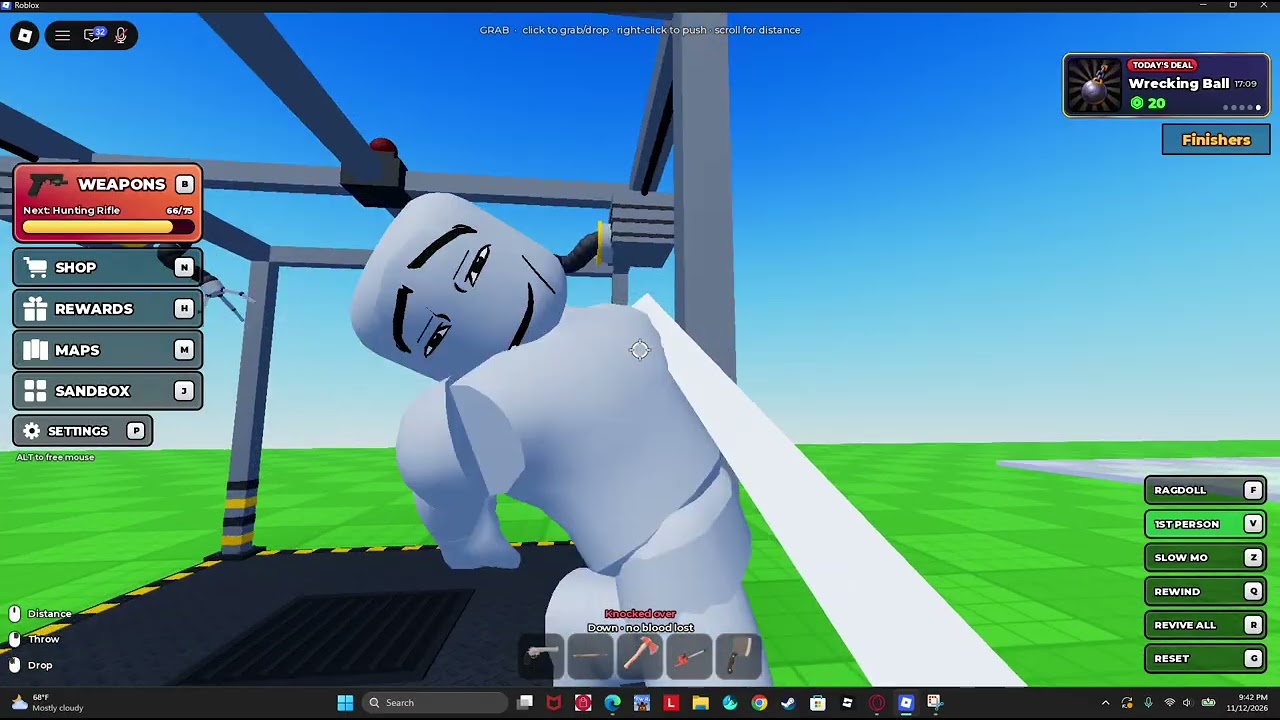
For Acid, the important action is putting the ragdoll into the liquid, not merely dragging it beside the pool. The available footage specifically describes putting the ragdoll in the acid. Test the placement with the ragdoll partly inside and then fully inside only if the scene makes those positions possible; the current material does not prove a boundary or a separate partial-contact result. Record the visible outcome in the moment, because no verified damage tick, survival time, or recovery rule is available.
Test Acid and Nuke hazards
These moments support the Acid placement test and the Nuke interaction described in this hazard guide.
After each test, reset the scene or generate another ragdoll if the current interface provides that option. The evidence mentions drawing or recalling ragdolls, but the exact UI label is uncertain, so this guide does not promise a particular button name. The useful comparison is one hazard at a time: Fire emphasizes continued burning, while Acid emphasizes contact with a corrosive area.
How to test Nuke and Train
Use Nuke as a controlled area-effect experiment. Keep the starting arrangement simple, place the target in a consistent location, and change only one variable on the next attempt—such as target spacing or the number of nearby objects. The evidence confirms that a nuke can be used and describes it as a high-destruction explosive effect, but it does not confirm whether the player must unlock it, whether it has a cooldown, or how its radius changes with distance. Avoid presenting it as a guaranteed one-hit result for every object.
Nuke tests can become difficult to interpret because a large blast may affect more than the intended ragdoll. Check whether the player, other ragdolls, tools, or scene objects are also displaced or destroyed, but describe only the outcomes you can see in the current game. “Large blast” is the supported decision rule; an exact radius or damage chart would be unsupported.
For Train, observe before interacting. The Roblox game description tells players to dodge the train, which supports treating it as a moving danger. The exact scene, route, arrival interval, collision result, and whether a hit kills, launches, or merely moves a ragdoll are not established. Find the route in the current scene, watch at least one pass, and keep the ragdoll away until you understand the timing. Then, if you choose to test contact, make the experiment reversible and do not infer a general rule from one collision.
Train should not be folded into the Fire, Acid, or Nuke instructions. Those hazards are tested by contact with a static area or by activating an explosive event; Train is tested by reading movement and timing. The safest useful guidance is therefore route awareness, not a promised dodge window.
Hazards versus tools and contraptions
Ragdoll Frenzy includes several ways to manipulate a ragdoll, but they do not all belong in the Hazards list. Fire, Acid, Nuke, and Train are the supported hazards because they represent environmental, moving, or area dangers. An axe is a tool used for direct interaction, while head-grabbing or tearing machines are contraption-style interactions. A tool can produce a harmful result without becoming a hazard category.
The game description also mentions shooting, blasting, grabbing, slow motion, and brutal finishers. Those phrases describe the broader sandbox and interaction set. They do not independently prove that “Blast” or “Slow-mo” is a separate hazard with its own entry. Keep them separate unless the current game menu identifies a dedicated hazard object and behavior.
This distinction helps when comparing tests. Choose Fire or Acid when the question is how an environment affects a ragdoll. Choose Nuke when the question is how a large explosion changes a group or nearby objects. Choose Train when the question is how movement and timing create danger. Choose a tool or contraption when the question is how a player-operated object manipulates the ragdoll.
What the current evidence does not establish
There is no reliable hazard stat sheet for damage, health loss, duration, radius, respawn time, cooldown, range, or unlock cost. The guide therefore uses broad effects and test actions instead of numbers. If the live game panel shows a value, requirement, or hazard name that differs from this reference, use that current in-game information for the mutable detail.
Train has the largest verification boundary: its existence is supported by the public game description, while its exact implementation is not. Nuke is clearer as an available explosive interaction, but the evidence still does not prove access conditions or blast measurements. Fire and Acid have the clearest recorded interactions, yet their exact damage rules remain unknown.
The practical takeaway is to use a controlled sandbox test: one ragdoll, one hazard, one changed variable, and a fresh reset between attempts. This produces a useful comparison without turning an observed visual effect into an unsupported statistic.
Ragdoll Frenzy hazards FAQ
Which hazards are confirmed in Ragdoll Frenzy?
Fire, Acid, and Nuke are the clearest recorded hazards. The public game description also tells players to dodge a Train, but its detailed behavior is not confirmed.
Does Fire instantly kill a ragdoll?
No instant-kill rule is established. Recorded gameplay shows a ragdoll burning and later dying, so treat Fire as persistent burning; its duration and damage rate are not confirmed.
How should I test Acid?
Grab a ragdoll and put it into the acid. The evidence supports that interaction, but not a precise damage value, survival time, or boundary range.
Is Nuke an instant one-hit hazard?
The evidence supports Nuke as a large explosive effect, not a universal one-hit rule. Its radius, cooldown, unlock condition, and target-specific damage are unconfirmed.
How can I avoid the Train?
Watch its route and timing before moving a ragdoll near it. The available evidence confirms that players should dodge the Train but does not establish a universal dodge window or collision outcome.